The history of FPL: from postal leagues to 13 million managers
Introduction
Fantasy Premier League (FPL), the Premier League's official fantasy game, launched in August 2002, ahead of the 2002/03 season. It is now the most widely played fantasy football game in the world. In 2025/26, 13.1 million managers entered a team, and the game now shapes how many supporters follow the Premier League each weekend.
The official game is younger than many assume, and it attracted only a modest following in its early seasons. Its roots lie further back: in American fantasy sports of the 1960s and 1980s, in an Italian adaptation for Serie A, and in the postal leagues and newspaper competitions that spread across England in the 1990s.
This article traces that history, from a handful of auction leagues in 1991 to the global game of today.
Do you want to play a retro fantasy football game of your favourite Premier League season?Check out the game on this very site.
Origins: an American idea
Fantasy sport began in the United States. In 1962 Bill Winkenbach, a part-owner of the Oakland Raiders, drew up the rules for a fantasy American football league with a Raiders publicist and an Oakland Tribune reporter. Their Greater Oakland Professional Pigskin Prognosticators League held its first draft at Winkenbach's home in August 1963.
The format that spread around the world came later. In 1980 the writer Daniel Okrent and a group of friends devised Rotisserie League Baseball, named after La Rotisserie Française, the New York restaurant where they met. Rotisserie established the principles that fantasy football would later adopt: a fixed budget, an auction for players and a league table built from real statistics.
The first version for actual football came from Italy. The journalist Riccardo Albini adapted the American idea for Serie A, playing it with friends from 1988 and publishing a rulebook in 1990. Fantacalcio became a national pastime after La Gazzetta dello Sport adopted it in 1994. The paper expected around 10,000 entrants and received 70,000.
1991: Fantasy League and the postal era
The first fantasy football game in England predates the Premier League itself. Andrew Wainstein was introduced to fantasy baseball by a family friend from the United States, and in 1991 he began building a database of top-flight players. He spent around four months devising a scoring system that rewarded goals and clean sheets. Borrowing from basketball, he also awarded points for assists, a statistic that English football did not then record as standard.
Wainstein's game, Fantasy League, was advertised in football magazines and run entirely by post. Managers paid a subscription and received an information pack. Each league then met in person, usually in a pub or a meeting room, to auction its players. Wainstein processed the results on a home computer and posted updated tables to managers, which typically arrived on Tuesdays.
The 1991/92 season attracted between 600 and 700 managers across 80 leagues. It was a modest start, but it established the model that newspapers would soon take to a far larger audience.
The 1990s newspaper boom
The Daily Telegraph turned fantasy football into a mass pursuit. Wainstein says he built the paper's game in January 1994, and 1994/95 was its first full season. Some accounts place the launch slightly earlier, before the 1993/94 season.
Entry was by post or premium-rate telephone line, with a deadline at Friday lunchtime, and results appeared in the Wednesday paper. The Telegraph reports around 342,000 entrants in its first full season, and its games consultant later put the 1995 figure at about 360,000. The paper was candid that the game existed to sell copies rather than to make money. As late as 2001, it declined to publish scores online because readers would then have no reason to buy the paper.
The first winner was Jonathan Roberts, a 12-year-old from Sutton Coldfield, who won a trip to watch a match of his choice anywhere in the world. Andy Cole's missed chances for Manchester United at Upton Park on the final day of 1994/95 decided both the real title and the fantasy one.
Other newspapers followed. The Sun launched Dream Team in the mid-1990s, scoring players on its reporters' match ratings and offering large cash prizes. The Times, the Mirror, The People, the Daily Star, the Daily Mail and the Glasgow Herald all ran games of their own. Most were later dropped, but the Telegraph and Sun games continue today.
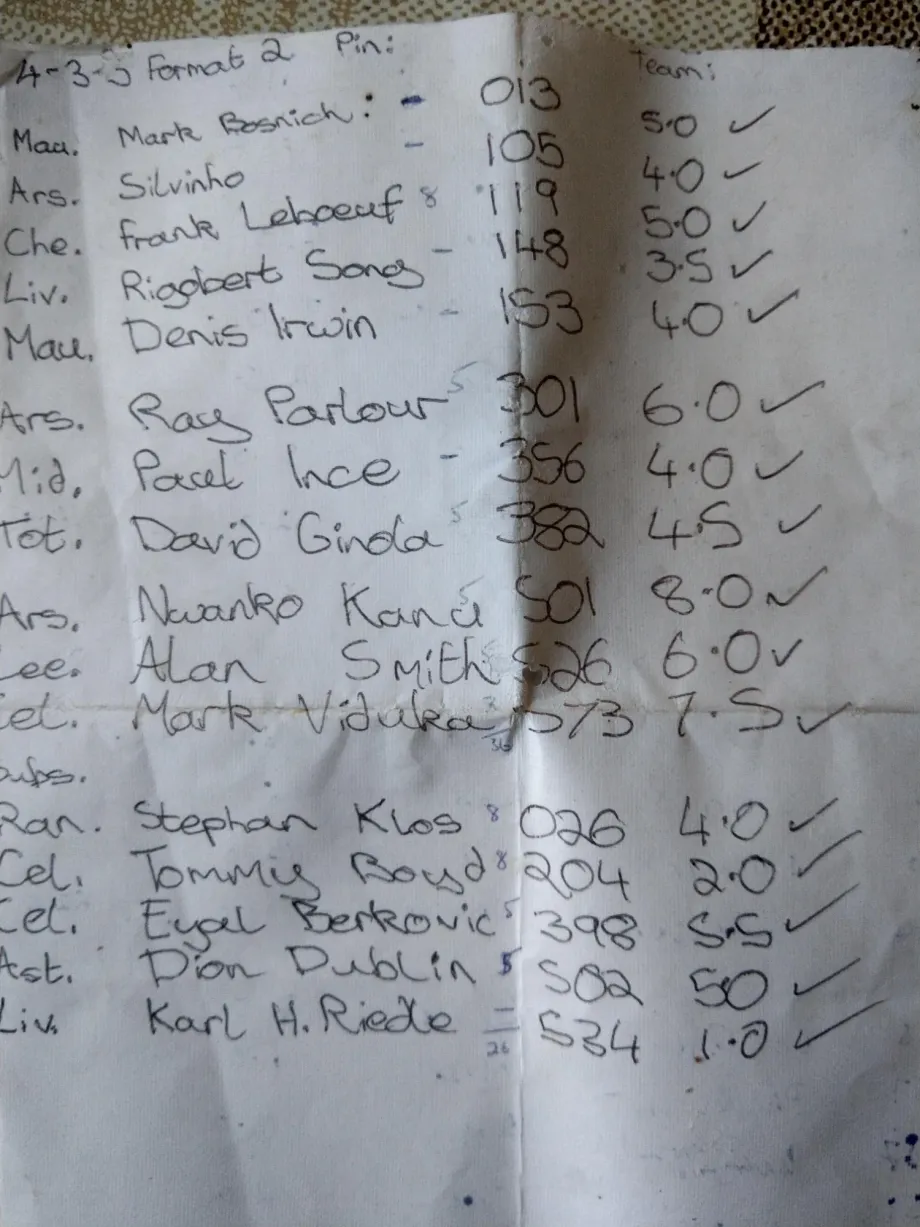
Fantasy Football League on television
Television made fantasy football part of popular culture. Fantasy Football League, presented by David Baddiel and Frank Skinner, began on BBC Two at 11.15pm on Friday 14 January 1994. It grew out of a BBC Radio 5 programme hosted by Dominik Diamond.
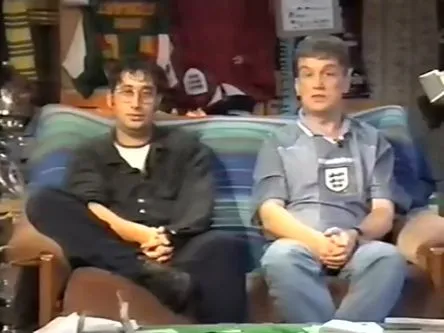
Celebrity guests managed teams in a real fantasy league, although Baddiel later said the league was mainly a framework for jokes about football, and it was eventually dropped. Angus Loughran appeared as "Statto", a statistician in a dressing gown. Three series ran until May 1996, spanning the1995/96 season, with specials during Euro 96. According to the British Comedy Guide, audiences reached six million, a record for comedy on BBC Two. The programme later moved to ITV and returned for Euro 2004. Its success also led Baddiel, Skinner and the Lightning Seeds to write "Three Lions" for Euro 96.
The timing was significant. The Premier League had begun in 1992, Sky's live coverage was changing how the game was watched, and premium-rate phone lines such as ClubCall were feeding demand for news and statistics. Fantasy football suited this new culture, and leagues among colleagues and friends in offices and pubs became its social centre.
Going online, 1999 to 2002
The internet changed how fantasy football was played. The Sun launched its web game, DreamTeamFC, in1999, with a £100,000 prize and entries at £5 online or by telephone. By 2001 the Telegraph allowed managers to make transfers online, and the number of transfers rose to well over a million. Fantasy League, meanwhile, took the game into classrooms: its 1999 schools competition involved 270 schools and about 24,000 pupils.
The dot-com boom also brought short-lived ventures. PremierWin offered a £1 million prize pool, supported by a £750,000 marketing campaign, and aimed for 250,000 subscribers. It went into liquidation after one season. Prizes elsewhere remained generous: for the 2002 World Cup, The Sun offered £100,000, the Telegraph £50,000 and The Times a Maserati.
The company that would build the official game was founded in this period. International Sports Multimedia (ISM) was formed in 1998 and produced a Champions League fantasy game in 1999. In 2000 it launched Can You Kick It?, a free Premier League game that drew 32,000 players in its first season,2000/01.
2002: the official game launches
The Premier League launched Fantasy Premier League in August 2002, ahead of the2002/03 season. The league was marking its tenth season with a new website, and the game was essentially a refined version of Can You Kick It?, built by ISM. It was free to enter, and the winner received a VIP trip to a Premier League match of their choice.
Several features will be familiar to managers today. Each squad held 15 players within a £100m budget, managers received one free transfer a week, and the scoring system was close to the current one. Others have long since disappeared:
- ten formations were permitted, including 2-5-3 and 5-5-0;
- some defenders, such as Tony Hibbert, cost £3.0m, while goalkeepers such as Jerzy Dudek cost £7.0m;
- Thierry Henry and Ruud van Nistelrooy were the most expensive forwards at £11.5m;
- midfielders received two points for a clean sheet;
- three bonus points went to any player judged to have made an excellent performance, with no limit on how many could receive them;
- unused transfers were lost, and there were no wildcards or chips;
- the first six gameweeks counted as a pre-season, so the overall competition ran over 32 gameweeks.
The counting season began with the Tyne-Wear derby on 21 September 2002. Interest was modest. The game launched with little publicity and finished its first season with 76,284 managers, fewer than a quarter of the Telegraph's peak entry.
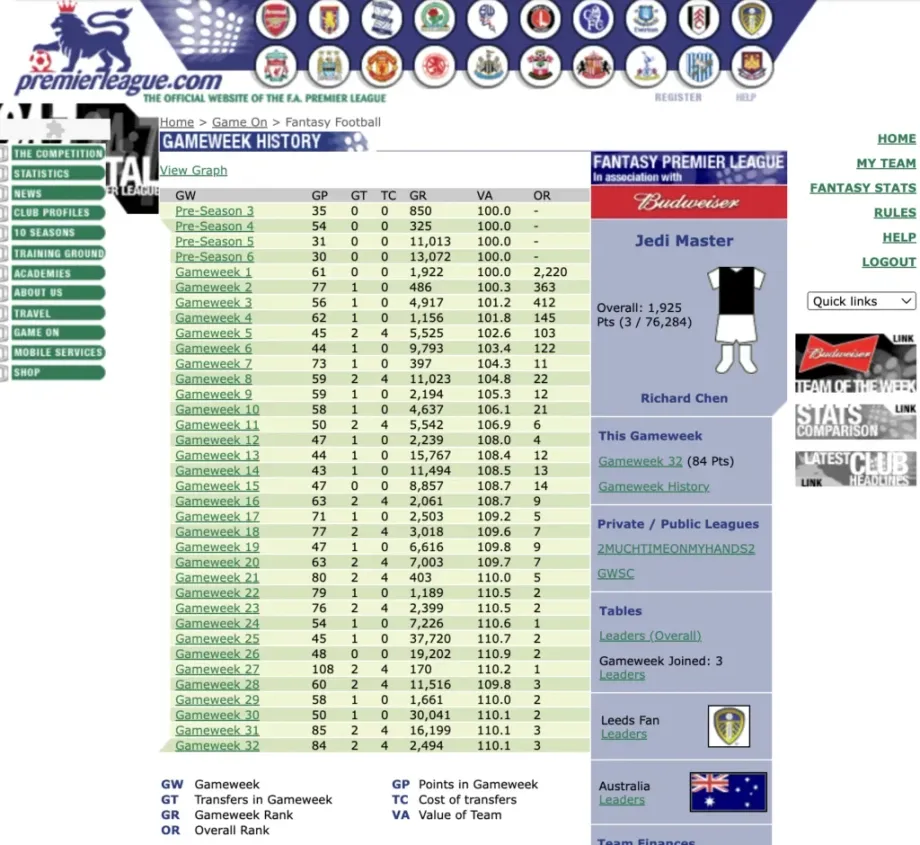
The first winner was Graeme Haddow, a Newcastle supporter, who finished six points clear with 1,940. No winner since has scored fewer than 2,000. Henry was the highest-scoring player, with 24 goals, 23 assists and 271 points.
Growth and rule changes, 2003 to 2015
The game grew quickly once word spread. Entries quadrupled in the second season, and in2006/07 FPL passed one million managers for the first time. The rules were refined as it grew. The 2-5-3 and 5-5-0 formations were removed in 2004/05, and from 2005/06 midfielders received one point for a clean sheet rather than two.
The bonus system moved steadily from judgement towards data. In the mid-2000s a statistics-based measure, the Actim Index, introduced the familiar scale of three, two and one bonus points. EA Sports' Player Performance Index took over in 2011/12. Opta then became the game's data provider, and its statistics formed the basis of the Bonus Points System (BPS), introduced in 2012/13 or 2013/14 (sources differ).
Managers also gained flexibility. The first wildcard arrived around 2008/09, and over the following seasons a second wildcard, the ability to carry over an unused free transfer, head-to-head leagues and the FPL Cup were added. Can You Kick It? ran alongside FPL until2010/11, when FPL took over its web address.
There were setbacks. When the relaunched website went live for 2011/12, many managers could not log in before the opening deadline, and FPL responded by granting a free wildcard. Thefollowing season, player numbers fell for the first time.
Chips, data and the modern game, 2015 to 2026
The introduction of chips in 2015/16 changed the game's strategy. Managers received the bench boost, triple captain and all out attack chips, and the wildcard was split into one for each half of the season. In 2017/18 the free hit replaced all out attack, and FPL passed five million managers.
Growth accelerated over the following seasons, and FPL passed ten million managers for the first time in2022/23. In 2024/25 managers could bank up to five free transfers, and a one-off assistant manager chip awarded points based on a real Premier League manager's results over three gameweeks.
The 2025/26 season brought the most significant changes since the game's launch. The assistant manager chip was withdrawn, and every chip became available twice, once in each half of the season. Defensive contribution points rewarded defenders who made ten combined clearances, blocks, interceptions and tackles, with a higher threshold for midfielders and forwards. Managers also received extra free transfers to cover the Africa Cup of Nations.
Further changes followed for 2026/27. Points, ranks and mini-league tables now update live during matches, with projected bonus points shown after 20 minutes. The BPS was rebalanced to reduce its overlap with defensive contributions, and the game added an official price-change predictor.
Winning scores have risen over the same period. Jamie Pigott set the record of 2,844 points in2021/22, and Mohamed Salah's 344 points in 2024/25 are the most scored by one player in a season. English managers won eight consecutive titles from 2009/10to 2016/17. Since then the title has gone overseas in all but one season, to managers from Tanzania, New Zealand, Ireland, the United States, Azerbaijan, Norway, Croatia and Denmark. The exception, Joshua Bull in 2019/20, was declared champion after the original leader was disqualified for breaching the game's terms.
FPL season by season
FPL grew from 76,000 managers to 13.1 million in its first 24 seasons, falling only in 2012/13 and 2023/24. Manager numbers are end-of-season totals and include inactive teams.
| Season | Managers | Overall winner | Winning score | Top-scoring player (points) |
|---|---|---|---|---|
| 2002/03 | 76k | Graeme Haddow | 1,940 | Thierry Henry (271) |
| 2003/04 | 312k | Muir O'Connor | 2,151 | Thierry Henry (242) |
| 2004/05 | 472k | Andy Tomlins | 2,253 | Frank Lampard (269) |
| 2005/06 | 810k | Tommy Wilson | 2,326 | Thierry Henry (239) |
| 2006/07 | 1.27m | Mike Dolan | 2,268 | Cristiano Ronaldo (244) |
| 2007/08 | 1.70m | John Frisina | 2,466 | Cristiano Ronaldo (283) |
| 2008/09 | 1.95m | Sir Moult | 2,264 | Frank Lampard (226) |
| 2009/10 | 2.10m | Jon Reeson | 2,668 | Frank Lampard (284) |
| 2010/11 | 2.35m | Chris McGurn | 2,372 | Nani (198) |
| 2011/12 | 2.78m | Sam Pater | 2,414 | Robin van Persie (269) |
| 2012/13 | 2.61m | Matt Martyniak | 2,472 | Robin van Persie (262) |
| 2013/14 | 3.22m | Tom Fenley | 2,634 | Luis Suárez (295) |
| 2014/15 | 3.50m | Simon March | 2,470 | Eden Hazard (233) |
| 2015/16 | 3.73m | Dimitri Nicolaou | 2,458 | Riyad Mahrez (240) |
| 2016/17 | 4.50m | Ben Crabtree | 2,564 | Alexis Sánchez (264) |
| 2017/18 | 5.19m | Yusuf Sheikh | 2,512 | Mohamed Salah (303) |
| 2018/19 | 6.32m | Adam Levy | 2,659 | Mohamed Salah (259) |
| 2019/20 | 7.63m | Joshua Bull | 2,557 | Kevin De Bruyne (251) |
| 2020/21 | 8.15m | Michael Coone | 2,680 | Bruno Fernandes (244) |
| 2021/22 | 9.17m | Jamie Pigott | 2,844 | Mohamed Salah (265) |
| 2022/23 | 11.45m | Ali Jahangirov | 2,776 | Erling Haaland (272) |
| 2023/24 | 10.91m | Jonas Sand Låbakk | 2,799 | Cole Palmer (244) |
| 2024/25 | 11.50m | Lovro Budišin | 2,810 | Mohamed Salah (344) |
| 2025/26 | 13.10m | Erik Ibsen | 2,582 | Erling Haaland (239) |
Source: Wikipedia, Fantasy Premier League, compiled from official FPL figures and ALLABOUTFPL.
The wider world of FPL
An advice industry has grown around the game. Early communities formed on forums such as FISO. Fantasy Football Scout, started as a blog by the games journalist Mark Sutherns in about 2007, became the leading source of statistics and analysis, with Opta-based tools and a long-running podcast, the Scoutcast. Fantasy Football Hub followed in 2019, selling predicted points and team ratings. YouTube channels such as Let's Talk FPL, FPL Focal and FPL Mate now have audiences in the hundreds of thousands, and some leading managers work as paid content creators.
Alternative formats have also developed. The Premier League launched FPL Draft in July 2017, reviving the auction-night principle that each player can belong to only one manager in a league. FPL Challenge, a single-gameweek mode, became a full game in 2024/25 and attracted 4.78 million players in 2025/26. The Telegraph and Sun games continue as paid competitions, and Sorare, a card-based game, signed a licensing deal with the Premier League in 2023.
Paid fantasy football is subject to gambling law. Under the Gambling Act 2005, a competition with paid entry, and prizes that depend on the number of entrants, can count as pool betting. DraftKings, licensed in 2015, offered paid daily fantasy contests in the UK from 2016 until it closed that business in 2024, while FanTeam continues under a pool betting licence. In 2017 the Gambling Commission warned amateur organisers that paid leagues could require a licence. Because FPL is free to enter, it falls outside these rules.
FPL today
FPL is now in its 25th season and has never been larger. In the opening gameweek of 2026/27, a record 814,606 managers played their bench boost chip. The game is played worldwide, but its culture of mini-leagues, deadline-day debate and office rivalries remains rooted in England.
The 2025/26 champion shows how far the game has travelled. Erik Ibsen, a 23-year-old Danish medical student, won by 38 points with 2,582, in his first season of play. The Telegraph's peak entry of 360,000 managers in 1995 would now amount to less than 3% of FPL's player base.
Much has changed since 1991. Auctions in pubs have given way to live scoring on phones, and tables sent by post to mini-league updates in real time. The principle Andrew Wainstein borrowed from American baseball remains the same: choose real players, follow their performances and compete with friends.
Pick a season and play it outSources and further reading
- ESPN, How Fantasy Premier League went from niche hobby to mainstream boom
- Fantasy Football Scout, The story of FPL's first season
- FISO, Daily Telegraph fantasy football and The Sun Dream Team
- FourFourTwo, the inside story of Fantasy Football League
- British Comedy Guide, Fantasy Football League
- FPL Tips, The online era of fantasy football and The FPL era
- ALLABOUTFPL, How many play FPL? and List of FPL winners
- Wikipedia, Fantasy Premier League and Rotisserie sports
- Premier League, Changes to Fantasy for 2025/26,What's new in 2026/27 andRecord bench boost in Gameweek 1
- Gambling Commission, Warning to fantasy football organisers